Introduction
The Adani–Hindenburg case is one of the most significant financial controversies in recent global business history. It began in January 2023 when Hindenburg Research, a U.S.-based short-selling investment firm, published a report accusing the Indian conglomerate Adani Group, led by billionaire Gautam Adani, of financial misconduct. The allegations sparked widespread debate in financial markets, politics, and corporate governance circles.
The report claimed that the Adani Group had engaged in stock price manipulation, accounting fraud, and improper use of offshore shell companies.
These accusations triggered a massive decline in the market value of Adani companies and raised questions about corporate transparency and regulatory oversight in India.
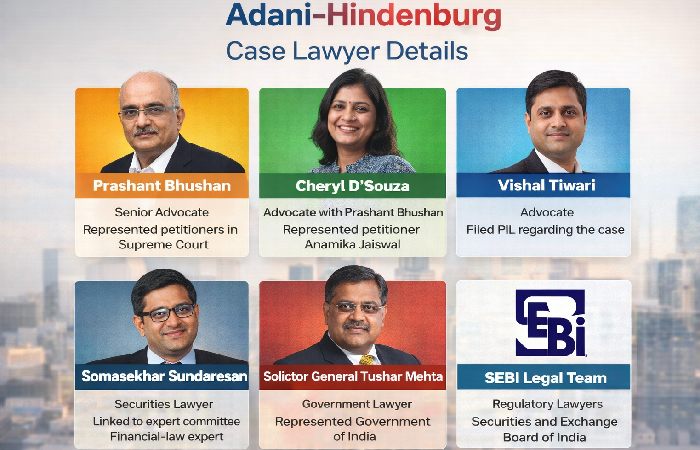
Adani–Hindenburg Case Lawyer Details
| Lawyer Name | Role in the Case | Represented / Position | Key Details |
| Prashant Bhushan | Senior Advocate | Represented petitioners in Supreme Court | Argued for an independent investigation into the allegations against Adani Group. (OpIndia) |
| Cheryl D’Souza | Advocate | Appeared with Prashant Bhushan | Assisted in representing petitioner Anamika Jaiswal in the case. (Scroll.in) |
| Vishal Tiwari | Advocate & Petitioner | Filed Public Interest Litigation | Requested a court-monitored probe into stock manipulation allegations. (India Today) |
| Somasekhar Sundaresan | Securities Lawyer | Linked to expert committee | A financial-law expert who has represented Adani in various regulatory forums earlier. (The Economic Times) |
| Solicitor General Tushar Mehta | Government Lawyer | Represented Government of India | Presented the government’s position during hearings in the Supreme Court (various proceedings). |
| SEBI Legal Team | Regulatory Lawyers | Represented Securities and Exchange Board of India | Defended SEBI’s investigation process before the court. |
Lawyer Fees in the Adani–Hindenburg Case
| Lawyer / Legal Team | Role in the Case | Estimated Fees / Charges | Notes |
| Prashant Bhushan | Senior Advocate representing petitioners | ₹3,00,000 – ₹10,00,000 per hearing | Fees depend on case complexity and number of hearings in the Supreme Court. |
| Cheryl D’Souza | Advocate assisting the petitioner team | ₹50,000 – ₹2,00,000 per hearing | Junior advocates usually assist with research and court filings. |
| Vishal Tiwari | Filed PIL regarding the case | Not publicly disclosed | As a petitioner advocate, fees may vary or sometimes be minimal in PIL cases. |
| Tushar Mehta | Represented Government of India | Government-fixed fees | Government law officers are paid according to official legal fee structures. |
| SEBI Legal Team | Represented Securities and Exchange Board of India | Government legal fees | Paid according to regulatory legal service rules. |
Background of the Adani Group
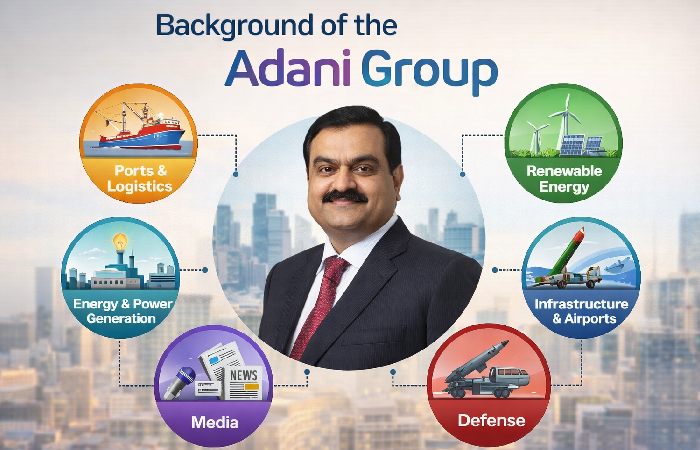
The Adani Group is one of India’s largest multinational conglomerates. Founded by Gautam Adani, the company operates in many sectors including:
-
Ports and logistics
-
Energy and power generation
-
Renewable energy
-
Mining and natural resources
-
Infrastructure and airports
-
Defense and media
The company experienced rapid growth in the 2010s and early 2020s. During this period, Gautam Adani became one of the richest people in the world.
However, the rapid rise in the stock prices of Adani companies attracted scrutiny from investors and analysts, which eventually led to the investigation conducted by Hindenburg Research.
Adani–Hindenburg Case: Key Allegations vs Responses
| Key Allegation by Hindenburg Research | Adani Group Response |
| Stock Price Manipulation | Hindenburg alleged that Adani companies manipulated share prices using offshore shell companies. |
| Use of Offshore Shell Companies | The report claimed that several shell companies were used to move money and inflate stock values. |
| High Debt Levels | Hindenburg argued that the Adani Group had excessive debt which could create financial risk. |
| Accounting Irregularities | The report suggested improper accounting practices and financial misreporting. |
| Corporate Governance Issues | Hindenburg alleged weak governance and lack of transparency in company operations. |
| Shareholding Transparency | Allegations were made about hidden promoters through foreign investors. |
| Market Manipulation via Related Parties | Hindenburg claimed related parties helped inflate stock prices. |
Impact on Global Markets
The Adani–Hindenburg controversy had a significant impact on global financial markets.
1. Investor Confidence
The case created uncertainty among investors, particularly those investing in emerging markets.
2. Corporate Governance Debate
The controversy sparked discussions about corporate transparency and governance standards in large conglomerates.
3. Regulatory Scrutiny
Regulators in India and other countries increased scrutiny of large corporations and their financial disclosures.
4. Foreign Investment Concerns
The case also raised questions about foreign investment risks in developing economies.
Overall, the controversy highlighted the importance of transparency, regulation, and investor protection.
Adani–Hindenburg Case Final Judgement
| Aspect | Details |
| Case Name | Adani–Hindenburg Controversy Case |
| Court | Supreme Court of India |
| Judgement Date | 03-Jan-24 |
| Main Issue | Allegations of stock manipulation and financial irregularities made by Hindenburg Research against Adani Group |
| Court Decision | The Supreme Court refused to transfer the investigation to an independent Special Investigation Team (SIT) |
| Investigation Authority | Securities and Exchange Board of India (SEBI) was allowed to continue its investigation |
| Court Observation | The court stated there was no sufficient evidence to doubt SEBI’s investigation |
| Status of Allegations | No final proof of wrongdoing was established by the court |
| Impact on Adani Group | Allowed the Adani Group companies to continue operations without court restrictions |
| Importance of Judgement | Reinforced trust in regulatory authorities and maintained market stability |
Investigations and Legal Proceedings
After the controversy emerged, several investigations were initiated.
SEBI Investigation
India’s market regulator, the Securities and Exchange Board of India (SEBI), launched an investigation into the allegations.
The investigation focused on:
-
Possible stock manipulation
-
Offshore fund structures
-
Compliance with shareholding rules
Supreme Court Case
Multiple petitions were filed in the Supreme Court of India requesting an independent investigation.
In January 2024, the Supreme Court refused to transfer the investigation to other agencies and allowed SEBI to continue its probe.
Conclusion
The Adani–Hindenburg case represents a major moment in global corporate and financial history. The controversy began with allegations of stock manipulation and financial irregularities but later evolved into a complex debate about corporate governance, market transparency, and regulatory oversight.
While the Adani Group denied all accusations and regulatory investigations have not established wrongdoing in key areas, the case had a massive impact on financial markets and investor sentiment.