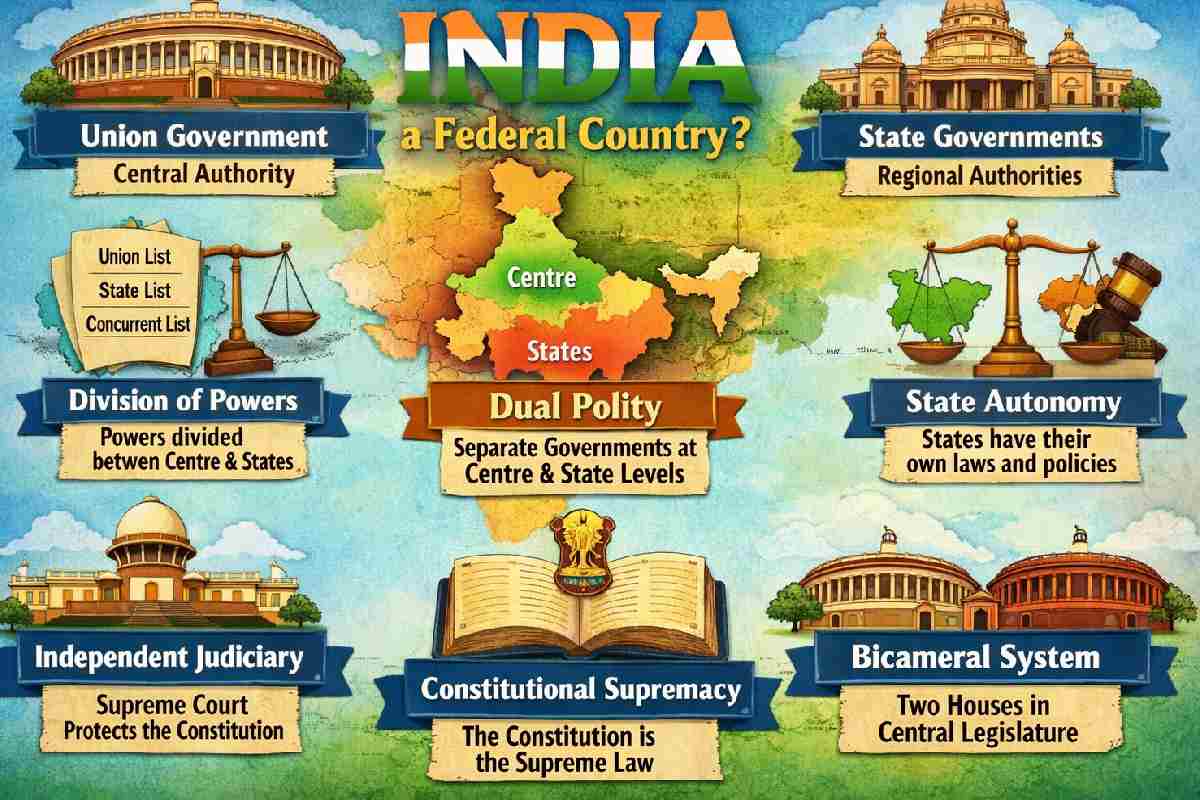
India is known as a country. This is because the Central Government and the State Governments of India share the powers of governance. They do this according to the Constitution of India.
This system is really helpful for India. It is a country with a lot of cultural diversity and regional differences. Even with these differences, India can maintain national unity. The system helps to manage India’s size and all the different cultures and regions that make up India.
India a Federal Country
After independence in 1947, India adopted its Constitution on 26 January 1950. The Constitution describes India as a “Union of States” (Article 1). Although the word federal is not directly used, the structure of government clearly shows federal characteristics.
India’s federal system was designed to:
-
Maintain national unity
-
Provide autonomy to states
-
Balance power between Centre and States
India as a Federal Country – Overview
| Aspect | Details |
| Type of Government | Federal with Unitary Bias (Quasi-Federal) |
| Levels of Government | Central, State (and Local bodies after 73rd & 74th Amendments) |
| Division of Powers | Union List, State List, Concurrent List |
| Highest Law | Constitution of India |
| Guardian of Constitution | Supreme Court of India |
India follows a dual polity, meaning two levels of government operate within their own areas of authority.
What Makes India a Federal Country?
Division of Powers
The Constitution divides subjects into three lists:
-
Union List – Centre makes laws
Example: Defence, Foreign Affairs, Railways -
State List – State governments make laws
Example: Police, Agriculture, Public Health -
Concurrent List – Both can make laws
Example: Education, Forests
Example:
The Central Government controls the Indian Army, but the Telangana Government controls state police.
Written Constitution
India has one of the longest written constitutions in the world. It clearly defines:
-
Powers of Centre
-
Powers of States
-
Rights of citizens
A written constitution is an essential feature of federalism.
Supremacy of the Constitution
The Constitution is the highest law. Neither the Centre nor the States can violate it.
Independent Judiciary
An independent judiciary ensures balance between Centre and States.
If disputes arise, the Supreme Court gives the final judgment.
Rigid Amendment Procedure
Some constitutional amendments require:
-
Special majority in Parliament
-
Approval of at least half of the states
This protects the federal structure.
Types of Federalism – Comparison
| Type of Federalism | Meaning | Key Feature | Example Countries |
| Coming Together Federalism | Independent states come together to form a larger nation | States are stronger than the Centre | USA, Switzerland, Australia |
| Holding Together Federalism | A large country divides power between Centre and States to maintain unity | Centre is stronger than the States | India, Spain, Belgium |
| Dual Federalism | Clear separation of powers between Centre and States | Each level works independently | USA |
| Cooperative Federalism | Centre and States work together for common goals | Shared responsibilities | India |
| Quasi-Federalism | Federal system with strong central authority | Unitary features during emergencies | India |
India as a Federal Country – Class
| Class Level | Understanding of Federalism |
| Class 6–7 | Power is shared between Centre and States |
| Class 8 | Constitution divides powers into lists |
| Class 9 | India is quasi-federal |
| Class 10+ | Cooperative & Fiscal Federalism studied |
Conclusion
India is a federal country inasmuch as it has constitutional provisions, division of powers, institutions and regional diversity. This system has permitted India to preserve the unity of the country with the vast plethora of difference that the country has. But the balance of power that has shifted towards centralisation in recent years remains a delicate and always developing characteristic of politics in India.
FAQs
1. Why is India called a Union of States?
Because states cannot secede from the Union.
2. How many lists are there in the Constitution?
Three – Union, State, and Concurrent.
3. Who resolves Centre-State disputes?
The Supreme Court of India.
4. Is India completely federal?
No, it has both federal and unitary features.
5. What is cooperative federalism?
It means Centre and States work together for national development.