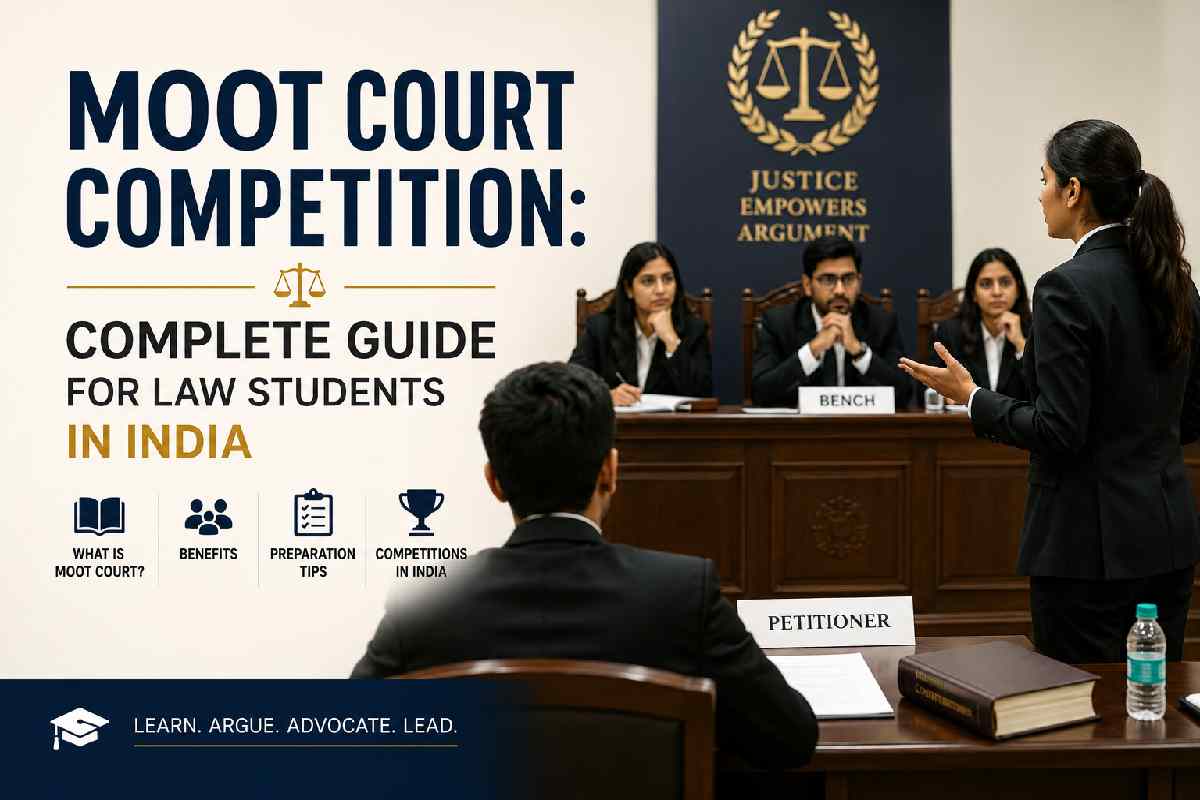


A moot court might be just another college task on paper, yet for many law students, it becomes something sharper – a chance to stretch their minds beyond the textbooks. Some find their voice there, others discover how fast thinking must snap under pressure. Across Indian campuses these events stand out, not loud or flashy but steady in purpose. They connect what lectures promise with what courts demand, stitching ideas into arguments that hold weight when challenged.
One step into constitutional law, criminal cases, arbitration, global regulations, or business-related statutes and students dive straight into mock trials. Not always by choice, yet these exercises build hands-on courtroom abilities quickly. First try or aiming high for nationwide rounds, each round shapes how arguments unfold under pressure. Structure matters more than most admit when voices rise and time runs short. Strategy hides not in grand speeches but quiet prep done long before standing up. A well-timed pause often outweighs rushed lines memorized overnight. Real edge comes from knowing where rules bend without breaking.
This guide covers all aspects of moot court events across India – starting from what they mean and how they’re structured, moving into writing memorials, handling spoken arguments, understanding how judges score performances, planning study routines, gaining advantages for future jobs. Every part connects clearly without skipping details needed to follow along easily.
What Is a Moot Court Competition?
A moot court competition is, like a pretend court case where law students talk about a made up problem in front of judges.
Law students usually get a proposition. This is a legal problem that is based on laws, parts of the constitution and what judges have said before.
Students then:
- research the legal issues,
- prepare written submissions called memorials,
- represent petitioner/appellant or respondent,
- present oral arguments before a judging panel,
- answer questions from judges.
Unlike debates, moots require legal reasoning supported by case law and statutes.
Think of it as courtroom practice before entering actual litigation.
Why Moot Court Competitions Matter for Law Students
Law school teaches legal concepts.
Mooting teaches how to use law effectively.
That difference matters.
A student may understand constitutional articles in theory but struggle when asked:
- Which precedent applies?
- Which statutory interpretation is stronger?
- How do you answer a judge’s question immediately?
- How do you defend weak facts?
Mooting trains exactly these abilities.
Key benefits:
1. Legal Research Skills
Students learn how to use:
- SCC Online
- Manupatra
- journal databases
- constitutional texts
- tribunal decisions
This builds practical legal research ability.
2. Memorial Drafting
Memorial drafting teaches:
- issue framing
- legal writing
- citations
- structured arguments
- persuasive submissions
These skills are valuable for:
- internships,
- judiciary preparation,
- litigation,
- LLM applications,
- law firm recruitment.
3. Courtroom Confidence
Many first-year students hesitate during public speaking.
Moots improve:
- confidence,
- courtroom etiquette,
- articulation,
- presence,
- argument delivery.
4. Analytical Thinking
Judges interrupt and challenge arguments.
Students learn:
- quick thinking,
- legal interpretation,
- rebuttal,
- responding under pressure.
5. Resume and Career Growth
Its national and international moot successes strengthen CVs.
They help with:
- internships,
- litigation chambers,
- placements,
- academic fellowships,
- scholarship applications.
Moot Court Competition Format in India
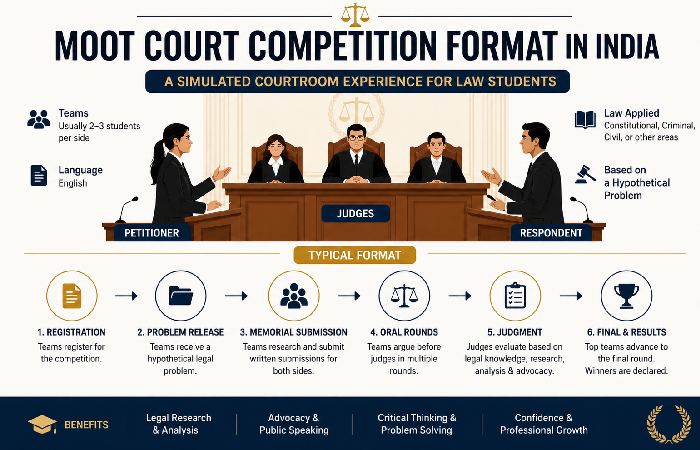
Most law schools and national competitions follow a structured format.
1. Moot Proposition Release
Organisers release a fictional dispute.
Example issues may involve:
- constitutional validity,
- arbitration dispute,
- environmental regulation,
- criminal liability,
- cyber law,
- corporate governance.
Students analyse:
- parties involved,
- relevant statutes,
- questions of law,
- procedural background.
2. Team Registration
Usually teams include:
| Team Member | Role |
| Speaker 1 | Oral submissions |
| Speaker 2 | Oral submissions |
| Researcher | Research + support |
Sometimes researchers also argue.
3. Memorial Submission
Written arguments are submitted before oral rounds.
Memorial structure generally includes:
| Section | Purpose |
| Cover Page | Team details |
| Index | Structure |
| List of Authorities | Cases/statutes |
| Statement of Jurisdiction | Court authority |
| Facts | Moot facts |
| Issues Raised | Questions of law |
| Summary of Arguments | Quick overview |
| Detailed Arguments | Core legal reasoning |
| Prayer | Relief requested |
4. Preliminary Rounds
Each team argues both sides:
- Petitioner/Appellant
- Respondent
Judges score performance.
5. Quarterfinal / Semifinal
Top scoring teams advance.
Competition becomes more intense.
6. Final Round
Finalists argue before senior judges or academics.
Sometimes panels include:
- retired judges,
- senior advocates,
- law professors,
- law firm partners.
Types of Moot Court Competitions in India
India hosts different levels of moot competitions.
Internal Moots
Conducted within colleges.
Best for beginners.
National Moot Court Competitions
Law schools across India participate.
Examples include competitions hosted by:
- National Law School of India University
- National Academy of Legal Studies and Research
- Faculty of Law, University of Delhi
- National Law University Delhi
International Moot Competitions
Examples:
- Philip C. Jessup International Law Moot Court Competition
- Vis Moot
These are prestigious and highly competitive.
How to Prepare for a Moot Court Competition
Preparation decides performance.
Here is a practical process.
Step 1: Read the Proposition Carefully
Read multiple times.
Highlight:
- parties,
- timeline,
- disputed facts,
- legal ambiguity,
- constitutional/statutory conflict.
Separate facts from assumptions.
Step 2: Identify Issues
Convert facts into legal questions.
Example:
- Is the statute unconstitutional?
- Was due process violated?
- Is jurisdiction valid?
Good issue framing improves memorial quality.
Step 3: Research Deeply
Use:
- Constitution of India
- statutes
- precedent
- comparative judgments
- legal journals
Search for:
- binding precedent,
- persuasive precedent,
- minority opinions,
- constitutional principles.
Step 4: Build Arguments
Structure:
Issue → Rule → Case Law → Analysis → Conclusion
This makes arguments persuasive.
Step 5: Draft Memorial
Keep language:
- formal,
- precise,
- logical.
Avoid emotional writing.
Focus on legal authority.
Step 6: Practice Oral Rounds
Practice repeatedly.
Include:
- time limits,
- rebuttal,
- judge questions,
- transitions.
Record yourself if possible.
Common Questions Asked by Moot Court Judges
Judges often ask:
- Which precedent is binding?
- Why should this court accept jurisdiction?
- What happens if facts change?
- Distinguish this case from precedent.
- Which constitutional article applies?
- What relief do you seek?
- Why is opposing counsel incorrect?
Strong mooters stay calm and answer directly.
Memorial Drafting Tips
A strong memorial matters before oral rounds begin.
Focus on:
Clarity
Short, precise legal sentences.
Citation Accuracy
Use correct citation style.
Logical Flow
Every argument should connect.
Strong Prayer
State relief clearly.
Balanced Argument
Prepare both sides thoroughly.
Mistakes Students Commonly Make
Avoid these:
| Mistake | Why It Hurts |
| Memorising blindly | Hard to answer judges |
| Weak citations | Reduces credibility |
| Ignoring facts | Argument becomes unstable |
| Poor teamwork | Confusion during rounds |
| Speaking too fast | Judges lose clarity |
| No rebuttal preparation | Lost scoring opportunities |
Moot Court Competition vs Debate Competition
| Moot Court | Debate |
| Legal argument | General argument |
| Based on law | Based on opinion |
| Memorial drafting | Usually no memorial |
| Judges ask legal questions | Broader rebuttal |
| Courtroom format | Debate format |
Mooting is legal advocacy.
Best Time to Start Mooting
You do not need to wait until final year.
Ideal:
First Year
Observe internal moots.
Second Year
Participate actively.
Third Year+
National competitions.
Earlier exposure helps.
How Mooting Helps Legal Careers
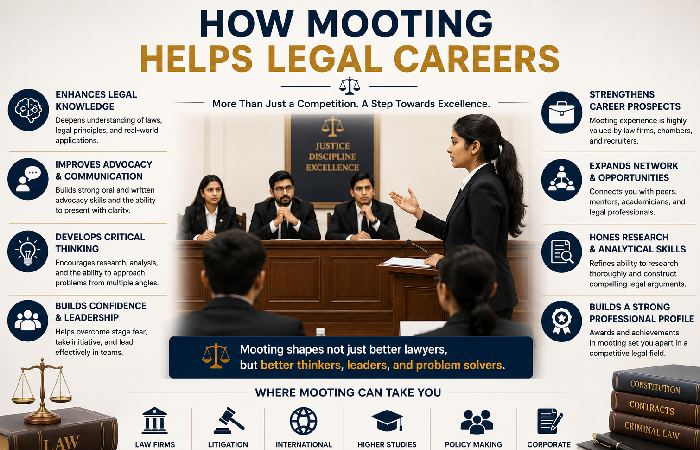
Mooting helps different career paths.
Litigation
Courtroom argument skills.
Judiciary
Legal reasoning.
Corporate Law
Research + drafting.
Academia
Analytical writing.
International Law
Cross-border legal reasoning.
Recruiters often value moot achievements.
Tips to Win a Moot Court Competition
Winning is not only about speaking well.
It includes:
Understand judges
Respond to their questions.
Know both sides
Prepare opponent arguments.
Strong researcher
Team research matters.
Practice rebuttals
Very important.
Stay professional
Courtroom etiquette matters.
Manage time
Finish arguments clearly.
Confidence with flexibility
Be prepared to pivot.
Future of Moot Court Competitions in India
Legal education in India is becoming more skill-focused.
Moot competitions are growing through:
- hybrid online rounds,
- international collaboration,
- specialised arbitration moots,
- cyber law moots,
- AI and privacy law themes,
- student legal research exposure.
For law students mooting is really a great way to learn things in a very practical way. Indian law students can get a lot of experience from mooting. Mooting is one of the things that Indian law students can do to learn and improve their skills.
Frequently Asked Questions
Is moot court compulsory in law school?
Lots of law colleges have something called moot court. They use this as a way to teach students. It is either part of the classes or something students do outside of class.
Can first-year students join moot court competitions?
Yes.
Internal competitions are ideal for beginners.
Is memorial drafting difficult?
Initially yes.
With practice it becomes easier.
Do moot court competitions help placements?
Yes.
They strengthen internships and CVs.
Which is the most famous moot court competition?
Internationally the Philip C. Jessup International Law Moot Court Competition is highly recognised.
Final Thoughts
A moot court competition is one of the most valuable experiences in legal education.
It teaches students how to:
- research like lawyers,
- draft like advocates,
- think critically,
- argue confidently,
- respond under pressure.
For Indian law students, moot court is not only a competition.
It is training for real legal practice.
Whether you are preparing for your internal round or you want to win a national championship doing consistent research practising and working as a team can help you become a confident legal professional.
Fahmeena Begum is a Legal Content Writer with 3+ years of content writing experience. She creates clear and reader-friendly informational content covering law, legal rights, court procedures and related topics.
Sameena Begum is a Legal Content Reviewer with 8 years of digital content experience. Her review work focuses on clarity, readability, consistency, structure and overall editorial quality.