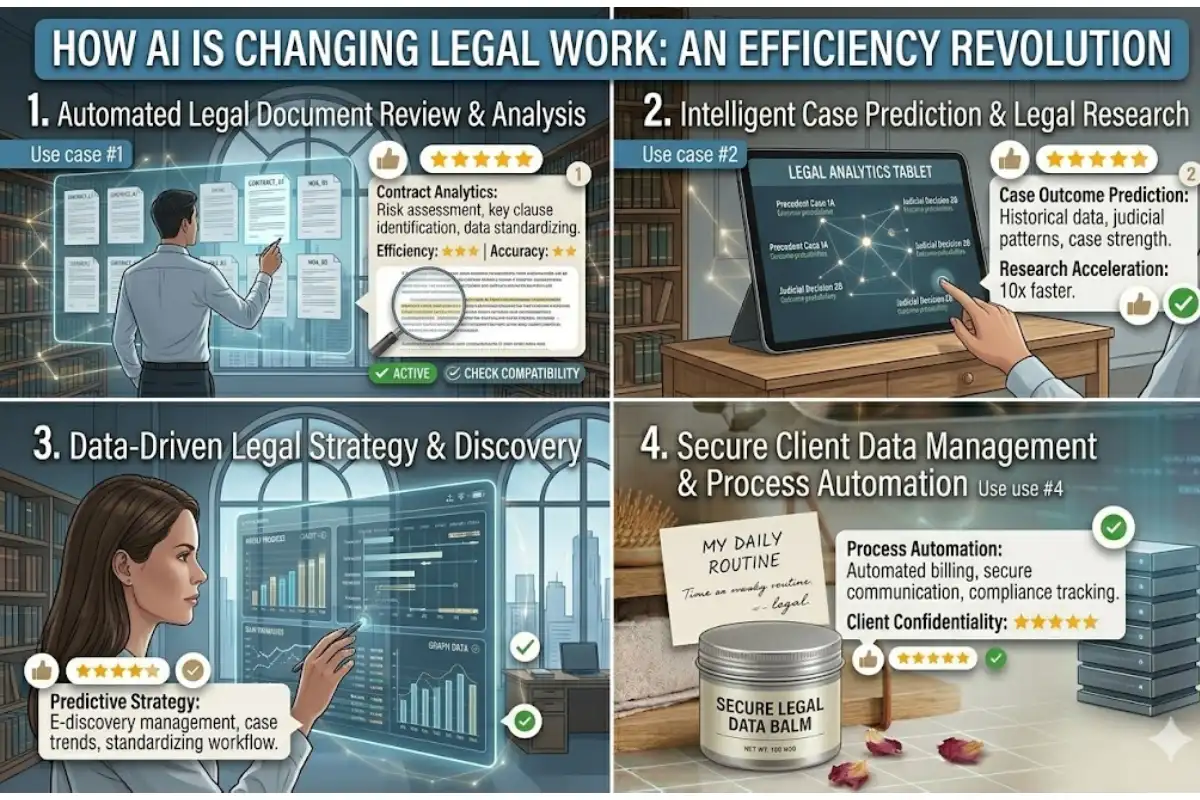
Artificial intelligence is transforming how solicitors, barristers, and legal teams handle their daily work. AI tools now help legal professionals research cases faster, review documents more efficiently, and predict case outcomes with greater accuracy than traditional methods alone. These changes are reshaping everything from small high street practices to large international firms.
Legal tech companies have introduced AI systems that can analyse thousands of contracts in hours rather than weeks. The technology handles routine tasks like document review and legal research, which previously consumed much of a lawyer’s time. This shift allows legal professionals to focus more on strategy, client relationships, and complex legal analysis.
However, AI in legal practice raises important questions about accuracy, ethics, and professional responsibility. As these tools become more common, the legal industry must balance innovation with maintaining high standards of service and protecting client interests. Understanding both the benefits and limitations of legal technology is essential for anyone working in or with the legal sector.
Core Transformations in Legal Practice
AI is reshaping how solicitors handle document review, conduct research, and charge for their services. These changes affect the daily operations of law firms and the economics of legal practice.
Automation of Document Review and Contract Analysis
Legal AI tools now handle tasks that once required teams of junior solicitors working long hours. Document review software can process thousands of pages in minutes, identifying relevant clauses, potential risks, and inconsistencies across contracts.
AI systems analyse agreements by comparing them against standard templates and flagging deviations. They spot missing provisions, conflicting terms, and unusual language that might create legal exposure. This technology reduces the time spent on due diligence from weeks to days.
Contract analysis platforms extract key data points such as termination dates, payment terms, and liability caps. They organise this information into searchable databases that solicitors can query instantly. The technology handles routine matters whilst lawyers focus on strategy and client relationships.
Tools like CoCounsel Legal demonstrate professional-grade AI capabilities in document review. These systems learn from each interaction, improving their accuracy over time. They work alongside human lawyers rather than replacing them entirely.
Enhancements in Legal Research with Generative AI
AI in legal research has moved beyond simple keyword searches. Generative AI systems now understand natural language questions and provide relevant case law, statutes, and legal commentary. They summarise lengthy judgements and highlight the most pertinent passages.
These tools analyse patterns across thousands of cases to predict potential outcomes. Solicitors receive answers to complex questions in seconds rather than hours. The technology identifies connections between cases that human researchers might miss.
Research platforms powered by AI suggest alternative legal theories and precedents. They update results automatically when new judgements are published. This ensures solicitors work with current information without constant manual checking.
Evolution of the Billable Hour Model
The billable hour model faces pressure as AI completes work in a fraction of traditional timeframes. Law firms that once charged for 20 hours of document review now complete the same task in two hours with AI assistance.
Some firms are shifting towards fixed fees and value-based pricing. Clients increasingly question paying hourly rates when technology handles much of the work. This forces solicitors to demonstrate the value they add beyond tasks that AI can automate.
Firms must balance investing in legal AI whilst maintaining profitability. The technology reduces revenue from routine work but allows solicitors to take on more complex matters. This transition period creates uncertainty about sustainable pricing models for legal services.
Leading Tools, Technologies, and Industry Reports
Several AI platforms now automate legal research, contract review, and document drafting, whilst recent industry reports reveal how firms are integrating these technologies into daily operations.
Prominent Legal AI Solutions and Their Impact
Harvey AI has emerged as a leading platform designed specifically for law firms. The tool assists solicitors with legal research, document analysis, and memo drafting using large language models trained on legal content. Major firms including Allen & Overy and Freshfields have deployed Harvey AI across their practices.
CoCounsel, developed by Thomson Reuters, functions as an AI legal assistant that handles tasks such as document review, deposition preparation, and timeline creation. The platform allows lawyers to delegate routine work whilst maintaining oversight of critical matters. Legal technology adoption has accelerated as these tools demonstrate measurable time savings.
Other legal AI tools address specific pain points. Contract review software can analyse agreements in minutes rather than hours. Legal research platforms provide case law summaries and identify relevant precedents faster than manual searches.
Key Insights from Generative AI in Professional Services Report
The 2025 Generative AI in Professional Services Report found that 78% of law firms have begun experimenting with AI tools. This Future of Professionals report identified document review and legal research as the most common initial applications.
Firms reported an average time reduction of 30-40% on research tasks when using AI assistants. However, the report also highlighted concerns about accuracy and the need for human verification of AI-generated work.
The study noted that mid-sized firms showed faster adoption rates than their larger counterparts, often due to fewer legacy systems and greater organisational flexibility. Partner-level support emerged as the strongest predictor of successful implementation.
Case Studies: Law Firms Adopting AI
A London-based commercial firm implemented CoCounsel for contract review across its corporate practice. The firm reduced contract analysis time by 35% whilst maintaining quality standards through lawyer oversight.
An international disputes team deployed Harvey AI to summarise case law and prepare research memos. Associates reported spending less time on initial research and more time on strategic analysis and client counselling.
A regional firm in Manchester adopted legal AI tools for due diligence work. The technology flagged potential issues in property documents, allowing solicitors to focus on complex title matters rather than routine checks.
Challenges, Risks, and Regulatory Considerations
AI in law presents significant obstacles related to accuracy, data protection, and compliance requirements. Legal professionals must address technical limitations, protect sensitive information, and adapt to evolving regulatory frameworks.
Addressing AI Hallucinations and Algorithmic Bias
AI hallucinations occur when systems generate false or fabricated information that appears credible. These errors pose serious risks in legal work, where accuracy is essential. A solicitor relying on AI-generated case citations might reference non-existent court decisions, leading to sanctions or malpractice claims.
Algorithmic bias represents another critical challenge. AI systems trained on historical legal data may perpetuate existing prejudices in sentencing recommendations or risk assessments. Studies have shown that some AI tools display bias based on race, gender, or socioeconomic status.
Law firms must implement verification processes to catch AI hallucinations. This includes having solicitors review all AI-generated content before use. Regular audits of AI systems help identify and correct bias in algorithms.
Navigating Data Privacy and Security
Legal work involves highly confidential client information subject to strict protection requirements. AI systems that process this data create new vulnerabilities. Cloud-based AI tools may store sensitive information on external servers, raising questions about data sovereignty and unauthorised access.
The UK GDPR imposes specific obligations on data processing, including requirements for client consent and data minimisation. Law firms using AI must ensure these tools comply with privacy regulations. They need clear policies about what data gets shared with AI providers.
Security breaches involving AI systems could expose privileged communications or case strategies. Firms should conduct thorough due diligence on AI vendors and implement robust encryption protocols.
Implications of AI Regulation for Legal Compliance
AI regulation is rapidly developing across jurisdictions. The EU AI Act classifies certain legal applications as high-risk, requiring conformity assessments and human oversight. Legal professionals must track these regulatory changes to ensure their AI tools remain compliant.
Professional bodies have begun issuing guidance on AI and law. The Law Society provides frameworks for responsible AI adoption in legal practice. Solicitors face potential disciplinary action if their use of AI violates professional conduct rules.
Firms must establish governance structures for AI deployment. This includes documenting AI decision-making processes and maintaining transparency with clients about AI use in their matters.
The Changing Role of Legal Professionals
AI tools are reshaping what lawyers do each day and the skills they need to succeed. Law firms must rethink how they train staff, develop junior lawyers, and demonstrate value to clients.
Skills and Training for the AI-Enabled Law Firm
Legal professionals now need technical skills alongside traditional legal expertise. They must understand how AI systems work, interpret their outputs, and know when to override automated suggestions. Many law firms require lawyers to complete training in legal tech platforms and data analysis.
Communication skills have become more important. Lawyers spend less time on routine tasks and more time explaining complex issues to clients. They need to translate AI-generated insights into practical advice.
Law schools are adding technology modules to their programmes. Students learn about AI in legal settings, data privacy, and algorithm bias. The “Future of Professionals Report” shows that graduates entering the market expect to work with AI tools from day one.
Continuing education programmes focus on prompt engineering for AI systems and quality control of automated work. Senior lawyers must learn to supervise AI-assisted junior staff effectively.
Impact on Junior Lawyers and Career Progression
The question “will AI replace lawyers” misses the real issue. AI changes how junior lawyers learn their craft. Traditional career paths relied on junior staff spending years reviewing documents and conducting research. AI now handles much of this work.
Junior lawyers face fewer opportunities to build skills through repetitive tasks. They need different ways to gain experience and judgement. Some firms create structured programmes where junior staff review and correct AI outputs to develop critical thinking.
Career progression timelines are shifting. Junior lawyers may advance faster in client-facing skills but need longer to develop certain technical abilities. Firms are redesigning promotion criteria to reflect these changes.
The risk exists that junior lawyers become too dependent on AI tools without understanding underlying legal principles. Law firms must balance efficiency gains with proper professional development.
Redefinition of Value in Client Engagement
Clients no longer pay premium rates for work that AI can complete quickly. Legal professionals must demonstrate value through strategic thinking, negotiation, and relationship management. The emphasis shifts from billable hours to outcomes and expertise.
Lawyers differentiate themselves through several key areas:
- Strategic advice – interpreting laws in the context of business goals
- Risk assessment – evaluating scenarios that AI cannot predict
- Negotiation – securing favourable terms through human interaction
- Regulatory navigation – guiding clients through changing compliance requirements
Transparent pricing models replace hourly billing at many firms. Clients want to know costs upfront and see clear benefits from AI in legal services. Legal professionals must articulate how technology improves their work rather than simply reducing fees.
The lawyer-client relationship becomes more collaborative. Clients access AI tools themselves and expect lawyers to add insight beyond what technology provides. This requires legal professionals to stay ahead of what AI capabilities exist and where human expertise remains essential.
Looking Forward: The Future of Legal Work with AI
AI will reshape law firms through new business models whilst expanding legal services to underserved populations. These changes will create both competitive pressures and opportunities for broader social benefit.
Innovation, Competitive Advantage, and AI-Native Firms
New law firms built around AI from the start are entering the market. These AI-native firms use legal tech as their foundation rather than adding it to existing processes. They can offer services at lower costs because they need fewer staff for routine tasks.
Traditional firms face pressure to adopt legal AI or risk losing clients. The generative AI in professional services report shows that firms using these tools complete work 30-40% faster. This speed advantage translates to competitive pricing and quicker turnarounds.
Key competitive factors include:
- Lower overhead costs through automation
- Faster document review and research
- 24/7 client service through AI assistants
- Data-driven insights for case strategy
Firms that integrate AI in law effectively will likely capture larger market shares. Those that resist may struggle to compete on price and efficiency.
Access to Justice and the Broader Social Impact
AI in legal services can help people who cannot afford lawyers. Automated tools can draft simple contracts, review tenancy agreements, and provide basic legal guidance at minimal cost.
Legal aid organisations use AI to serve more clients with limited budgets. Chatbots answer common questions about rights and procedures. Document automation helps people file court papers correctly without paying solicitor fees.
However, AI cannot replace lawyers for complex cases. The technology works best for straightforward matters like small claims or standard divorces. People still need human solicitors for trials, negotiations, and nuanced legal advice.
The technology reduces costs but requires internet access and digital literacy. This means some vulnerable populations may still face barriers to legal help.