
Introduction
Fingerprints are one of the most unique and reliable biological features used for human identification. The patterns formed by ridges on our fingertips are called dermatoglyphics, and no two individuals (even identical twins) have exactly the same fingerprints. These patterns are formed before birth and remain unchanged throughout life, making them extremely useful in forensic science, security systems, and biometric authentication.
The study of fingerprint patterns dates back to the 19th century, when scientists like Sir Francis Galton classified them into basic groups. Today, fingerprints are broadly categorized into three main types, with several subtypes and variations. This article provides a complete explanation of fingerprint types, their characteristics, classification, and practical applications.
What Are Fingerprints?
Fingerprints are the impressions left by the friction ridges present on the skin of fingers. These ridges help improve grip and sensitivity. Each fingerprint consists of patterns such as loops, whorls, and arches, which are used for identification purposes.
Main Types of Fingerprints
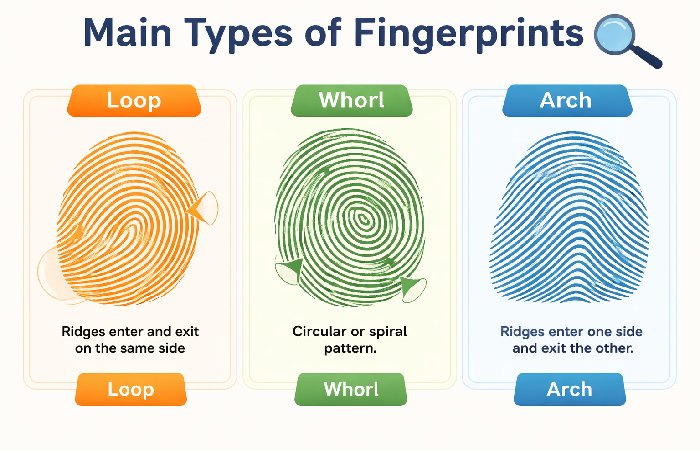
There are three primary types of fingerprint patterns:
| Fingerprint Type | Description | Key Feature | Prevalence |
| Loops | Ridges enter and exit on the same side | One delta, curved pattern | Most common (~60–65%) |
| Whorls | Circular or spiral patterns | Two or more deltas | Second most common (~30–35%) |
| Arches | Ridges enter one side and exit the other | No delta, wave-like shape | Least common (~5%) |
These three categories form the foundation of fingerprint classification in forensic science.
1. Loop Fingerprints
Loop fingerprints are the most common type found in humans.
Characteristics
- Ridges enter from one side of the finger
- Curve around a central point (core)
- Exit from the same side
- Contain one delta (triangular region)
Loops account for around 60–65% of all fingerprints, making them the most frequently observed pattern.
Types of Loops
| Loop Type | Direction | Description |
| Ulnar Loop | Toward little finger | Most common loop type |
| Radial Loop | Toward thumb | Less common |
Importance
Loops are widely used in forensic identification because their ridge count and structure help differentiate individuals.
2. Whorl Fingerprints
Whorls are circular or spiral-shaped fingerprint patterns.
Characteristics
- Circular or spiral ridges
- At least two deltas
- Complex and symmetrical structure
Whorls make up about 30–35% of fingerprints.
Types of Whorls
| Whorl Type | Description |
| Plain Whorl | Simple circular pattern |
| Central Pocket Loop | Loop with a circular core |
| Double Loop | Two loops combined |
| Accidental Whorl | Irregular combination pattern |
Importance
Whorls are highly distinctive and provide strong identification evidence due to their complexity.
3. Arch Fingerprints
Arches are the simplest and rarest fingerprint type.
Characteristics
- Ridges enter from one side
- Rise in the center like a wave
- Exit from the opposite side
- Usually no delta or core
Arches account for only about 5% of fingerprints.
Types of Arches
| Arch Type | Description |
| Plain Arch | Smooth wave-like pattern |
| Tented Arch | Sharp peak in the center |
Importance
Although simple, arches are useful in eliminating suspects in forensic investigations.
Additional (Composite) Fingerprint Types
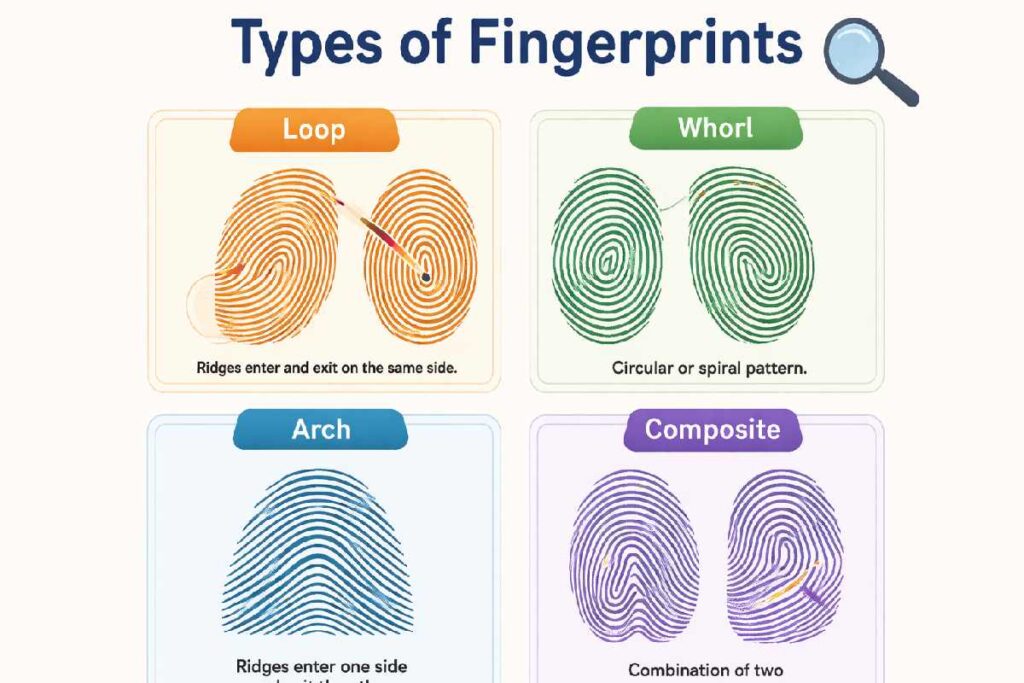
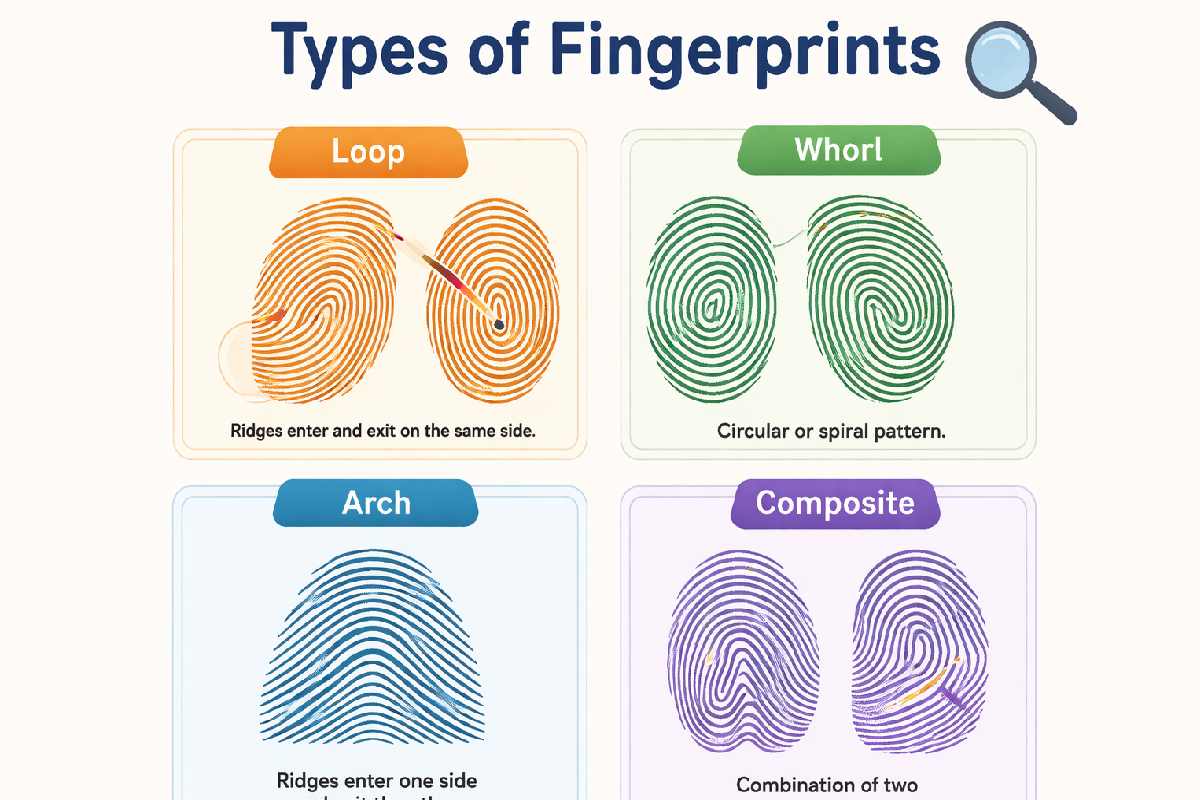
Apart from the main three types, some fingerprints show mixed or composite patterns.
| Type | Description |
| Composite | Combination of loop, whorl, or arch |
| Central Pocket Loop | Whorl inside a loop |
| Double Loop | Two loops forming one pattern |
| Accidental | Irregular pattern not fitting others |
Composite patterns are less common but important in advanced fingerprint analysis.
Key Features Used in Fingerprint Identification
Fingerprint experts study several features:
| Feature | Description |
| Core | Center of the fingerprint pattern |
| Delta | Triangular meeting point of ridges |
| Ridge Count | Number of ridges between core and delta |
| Minutiae | Small details like ridge endings and bifurcations |
These features help forensic experts match fingerprints accurately.
Formation of Fingerprints
Fingerprints develop during the fetal stage and remain unchanged throughout life.
| Stage | Description |
| Early Development | Skin layers begin forming |
| Ridge Formation | Dermis pushes against epidermis |
| Final Pattern | Permanent ridges form before birth |
Uses of Fingerprints
Fingerprints are widely used in many fields:
- Forensic Science
- Crime investigation
- Identifying suspects
- Security Systems
- Mobile phone unlocking
- Biometric authentication
- Government Records
- Aadhaar identification in India
- Passport verification
- Banking and Finance
- Secure transactions
- Identity verification
Advantages of Fingerprints
| Advantage | Explanation |
| Unique | No two people have identical fingerprints |
| Permanent | Do not change over time |
| Reliable | High accuracy in identification |
| Easy to Collect | Simple and non-invasive |
Limitations of Fingerprints
| Limitation | Explanation |
| Damage | Cuts or burns may affect patterns |
| Partial Prints | Hard to identify incomplete prints |
| Similar Patterns | Some patterns may look similar |
Modern Fingerprint Technology
Today, fingerprint analysis uses advanced technologies:
- Automated Fingerprint Identification System (AFIS)
- Digital scanners
- AI-based matching systems
These technologies improve speed and accuracy in identification.
Conclusion
Fingerprint patterns are one of the most important tools in personal identification. The three main types—loops, whorls, and arches—form the basis of fingerprint classification. Each type has unique characteristics that help forensic experts distinguish individuals with high accuracy.
With advancements in technology, fingerprint analysis has become even more reliable and widely used in security systems, law enforcement, and everyday applications. Understanding the types of fingerprints not only helps in academic learning but also provides insight into one of the most fascinating aspects of human biology.
FAQs
- What are the main types of fingerprints?
The three main types are loops, whorls, and arches.
- Which fingerprint type is most common?
Loops are the most common, found in about 60–65% of people.
- Which fingerprint type is rarest?
Arches are the rarest, found in about 5% of people.
- Are fingerprints permanent?
Yes, fingerprints are formed before birth and remain unchanged throughout life.
- Can a person have different fingerprint types?
Yes, a person can have different types of fingerprints on different fingers.